
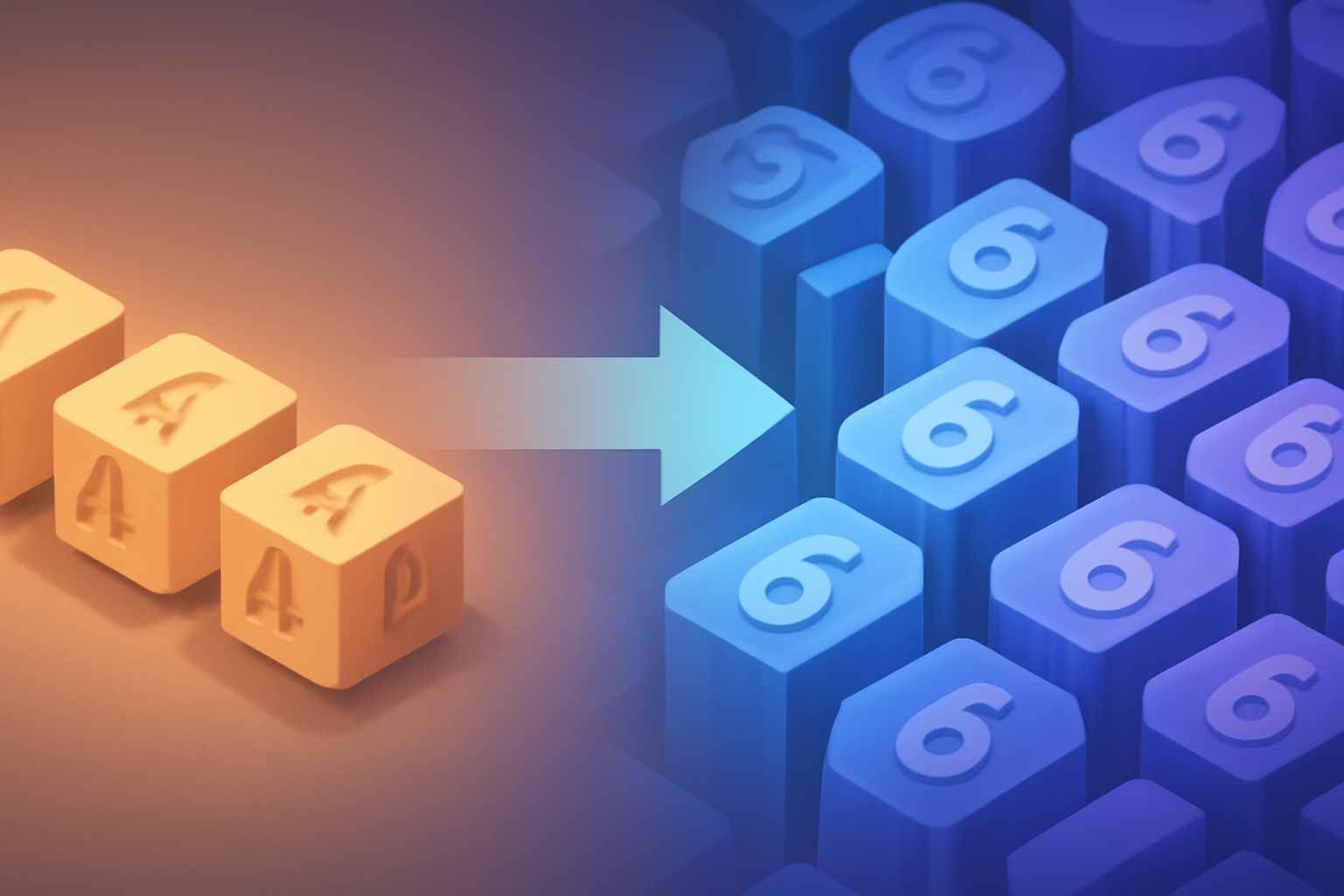
In 2011 the regional internet registry for Asia-Pacific ran out of fresh IPv4 addresses to hand out. Nobody really noticed, because nothing obvious broke. Another registry ran out in 2015, and another in 2019. The public internet kept humming along. Meanwhile, a protocol called IPv6, which had been standardised back in 1998, was quietly getting deployed everywhere, and in 2026 it's now carrying roughly 45 percent of Google's global traffic. Half the internet, running on an address system most people have never seen.
This guide is the version that actually explains IPv6 without making you want to nap. We'll cover what changed, why IPv4 somehow still survives, and the handful of practical situations where the difference actually matters to you.
TL;DR
- IPv4 has ~4.3 billion addresses; IPv6 has ~340 undecillion. We ran out of IPv4 roughly fifteen years ago.
- You probably use both at the same time already. Most home ISPs in the US, UK, Germany, France, Japan and India deliver dual-stack.
- For 99% of users, nothing works differently. The day you'll care is when you're diagnosing "my port-forward stopped working" or "why is my IP suddenly a :: :: :: thing".
The address format, at a glance
IPv4 is four numbers 0–255 separated by dots: 203.0.113.42. Easy to memorise, easy to type. Under the hood it's a 32-bit integer.
IPv6 is eight groups of four hex digits separated by colons: 2001:0db8:85a3:0000:0000:8a2e:0370:7334. Under the hood it's a 128-bit integer, which is why the address space is so absurdly big. Adjacent zero groups collapse to `::` once per address, so the example above usually gets written 2001:db8:85a3::8a2e:370:7334. More readable than it looks.
Why the size difference matters
4.3 billion sounds like a lot. It is not, when every iPhone, doorbell camera, EV charger and smart washing machine wants a unique address. IPv6 was sized, by policy, so every grain of sand on Earth could get its own /64 subnet. The design goal wasn't just "more addresses"; it was "never run out again".
Why IPv4 still won't die
If IPv6 is so much better, why are we not all on it? Because the internet is a living museum of backwards compatibility. Three things conspired to keep IPv4 alive long past its sell-by date:
NAT was a miracle
Network Address Translation (NAT) lets a router share a single public IPv4 across an entire household or office. Combine that with CGNAT (carrier-grade NAT, which shares IPv4s across thousands of customers at the ISP level) and you can cram a very large audience behind very few addresses. NAT was supposed to be a stopgap. It's now older than most employees at your local ISP.
Software momentum
Decades of code, firewalls, scripts and documentation were written assuming IPv4. Every migration is a risk. Enterprises that found a way to ignore IPv6 did so.
No user-visible benefit
For the user, IPv6 feels identical to IPv4. Nobody's YouTube buffers faster, nobody's Slack works better. Invisible upgrades are the hardest upgrades to fund.
2026 adoption snapshot
Public IPv6 adoption numbers worth remembering:
- Google's global measurement: ~45% of traffic is IPv6.
- India leads the world at ~75% (thanks to Jio launching IPv6-native).
- United States, France, Germany, Belgium: 50–70% depending on the week.
- China, Russia, South Korea: surprisingly low — well under 30%, for a mix of policy and infrastructure reasons.
- Most mobile networks worldwide: IPv6-first by default.
If you're on a smartphone right now and reading this over mobile data, you're almost certainly on IPv6.
The practical differences for a user
In 2026, most of the differences that matter to normal humans come down to these:
Port forwarding
On pure IPv4, port forwarding is a solved problem but has weird edges because of CGNAT — your ISP might refuse you a real public IPv4 and put you behind a shared one, where nothing inbound works. On IPv6, you don't need port forwarding at all, because every device gets a globally-routable address. You still need your firewall to allow the connection, but there's no translation trickery.
Hosting from home
If you self-host — Plex, Home Assistant, a Minecraft server — IPv6 is noticeably easier. Your ISP gives you a /56 or /60 prefix, every device gets a public address, and you can reach any of them from outside without NAT gymnastics. Many home routers make this easy now (UniFi, MikroTik, even ordinary ISP boxes).
Privacy
IPv6 address privacy got a lot of attention because early versions baked your MAC address into the lower 64 bits — a stable fingerprint. That's fixed: every operating system now defaults to privacy extensions (RFC 4941/8981) that rotate the lower bits every day or two. In practice, your tracking surface is similar on IPv4 and IPv6, with IPv4 slightly easier to lump many users under a shared public IP and IPv6 slightly harder to long-term fingerprint.
Geolocation
GeoIP databases tend to be a little newer and rougher on IPv6, which means "wrong country" glitches are more common when you connect over IPv6. If Netflix is misbehaving, a common fix is disabling IPv6 on that single device to force it back onto IPv4 where the databases have decades of history.
Should you disable IPv4 or IPv6?
Short answer: no, leave both enabled. The internet works best as dual-stack in 2026, and your OS is smart enough to prefer whichever is faster via Happy Eyeballs (RFC 8305).
The times it makes sense to disable one, just on the affected device:
- An app or service is misbehaving with GeoIP → disable IPv6 on that device, try again.
- Your ISP is giving you terrible IPv4 performance (high packet loss, CGNAT issues) → prefer IPv6, disable IPv4 where possible. Rare, but it happens.
- You're a network engineer knee-deep in debugging, in which case you don't need this article.
A table you can actually use
IPv4
Address: 4 decimal octets
Format example: 203.0.113.42
Total pool: ~4.3 billion
NAT: near-universal (home + ISP)
Port forwarding: needed, often broken by CGNAT
GeoIP accuracy: mature, high
IPv6
Address: 8 hex groups
Format example: 2001:db8::1
Total pool: ~340 undecillion
NAT: almost never
Port forwarding: not needed, direct routing
GeoIP accuracy: still maturing, sometimes wrong
How to find out what you're actually using
Open our IP lookup tool. If it shows an address with colons, you're IPv6. If it's four dotted numbers, you're IPv4. Visit test-ipv6.com for a detailed scorecard.
On any OS, the command line tells you directly:
# macOS / Linux
ip -6 addr # IPv6 addresses
ip addr # both
# Windows PowerShell
Get-NetIPAddress
Common misconceptions
"IPv6 is faster than IPv4"
Not inherently. What IPv6 avoids is multi-level NAT translation, which can add a few milliseconds per hop. On short paths the difference is noise; over CGNAT-heavy paths it can be measurable. Don't switch expecting the internet to feel different.
"IPv6 fixes tracking"
No. Modern web tracking uses cookies, fingerprinting and logged-in accounts. Your IP is a minor signal either way. IPv6 does make it harder to ban an entire household at once, because each device is on a different address.
"IPv6 is insecure because every device has a public address"
A public IP isn't a security problem; a firewall that allows unsolicited inbound traffic is. Every major router that ships with IPv6 enabled also ships with a default-deny inbound firewall. The security story is about equal.
FAQ
Will IPv4 ever fully disappear?
Eventually, but not in this decade. There's too much gear, too many scripts, too much inertia. The realistic path is: new deployments are IPv6-first, legacy systems stay IPv4 behind translation gateways, the overlap shrinks gradually.
Why does my IPv6 address change every day?
Privacy extensions. Your OS rotates the lower 64 bits to make long-term tracking harder. Your stable address is still there (typically marked "permanent") for incoming connections.
Do I need to pay more for IPv6?
No. Every major ISP gives IPv6 for free as part of the standard package. You shouldn't pay anything extra.
My router says I have IPv6 but websites still show an IPv4 address — why?
Because that specific website hasn't enabled IPv6 on their end. Amazon, Facebook, YouTube, Cloudflare are IPv6-ready. Many smaller sites aren't. Your device will silently fall back to IPv4 for those.
Is IPv6 supported in my VPN?
Most major VPN providers now route IPv6 or explicitly block it to prevent leaks. Check your VPN's leak-test page. Our Security Check will flag a mismatch.
Tools on ip-checker.pro that help
→ IP Lookup — shows your current IPv4 and IPv6
→ DNS Lookup — A (IPv4) and AAAA (IPv6) records for any domain
→ Port Checker — test whether a port is reachable on your current IP