
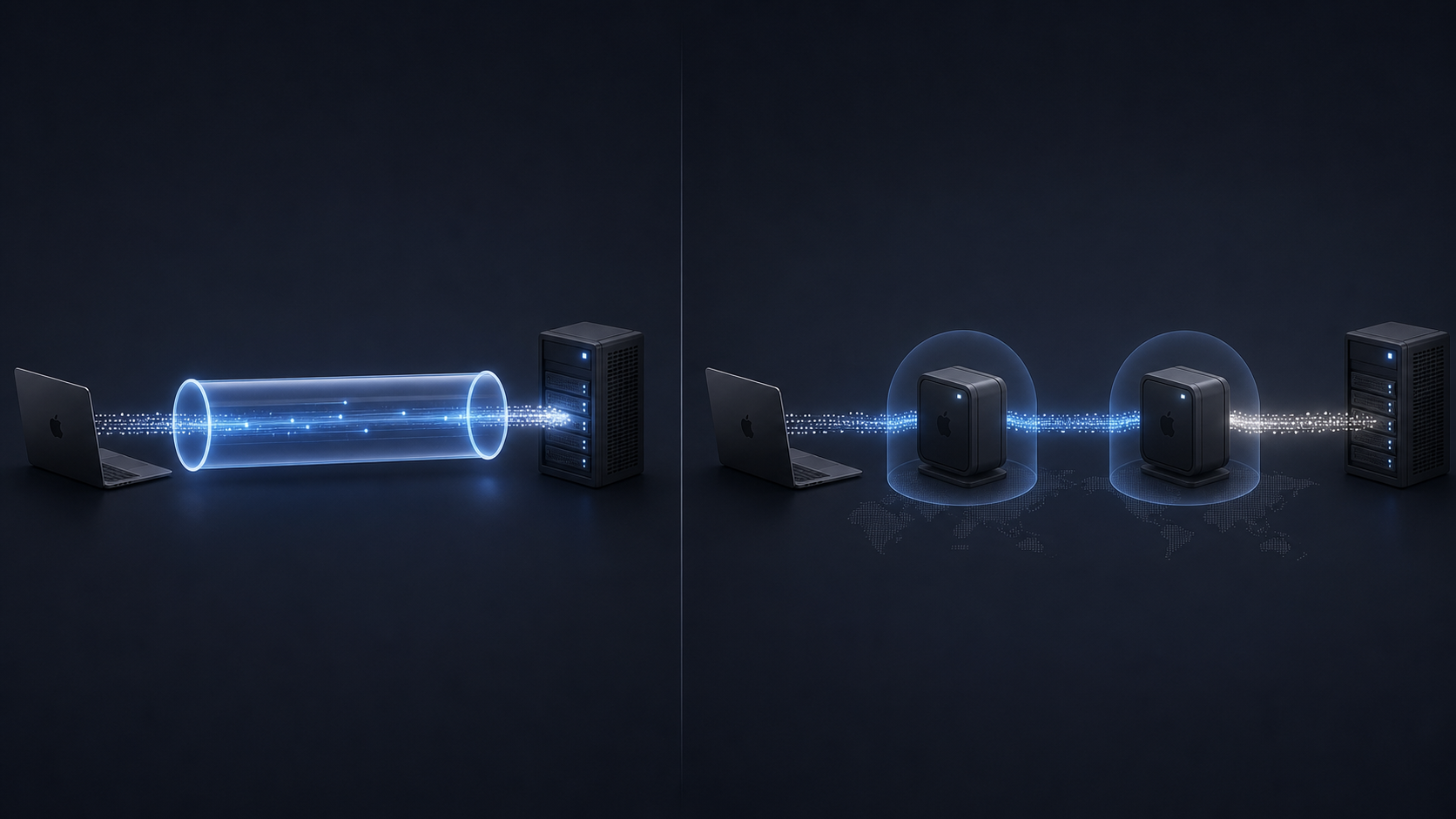
Apple launched Private Relay with iOS 15 in September 2021. The marketing framed it as a privacy feature that prevents anyone from seeing both who you are and what you are browsing. That claim is technically accurate, and the architecture behind it is genuinely interesting. But it is not a VPN, and understanding the difference matters when you are trying to decide whether it actually protects you.
How Private Relay works
Private Relay uses a two-hop architecture. When you browse in Safari with iCloud+ active, your request does not go directly to the destination. It goes first to an Apple-operated ingress proxy, which knows your IP address but cannot see the destination hostname because it is encrypted. The request then goes to an egress proxy operated by one of Apple's partners (Cloudflare and Fastly are among them), which can see the destination but only knows that the connection came from the Apple proxy, not from you specifically.
The result is that no single entity sees both your IP and your browsing destination. Apple sees your IP but not where you are going. The CDN partner sees where you are going but not your real IP. The destination website sees only the egress proxy IP.
This is a meaningfully stronger privacy guarantee than a conventional VPN for some threat models. With a VPN, the VPN provider sees everything: your real IP, the destination, and the timing of your requests. You have traded surveillance from your ISP for surveillance from your VPN provider. With Private Relay, neither hop has the full picture.
What it does not do
Private Relay is not a system-wide anonymity tool. It covers Safari browsing and DNS queries associated with those browsing sessions. It does not apply to other browsers, to other apps on your device, or to any traffic that is not web browsing. Install Chrome on your iPhone, browse with it, and your ISP sees everything.
It does not change your apparent country. Apple uses what they call "generalized" geolocation, meaning the egress IP is in the same country and approximate region as you. If you are in Germany, your traffic exits from a German IP. This is intentional for regulatory reasons, but it means Private Relay cannot help you access region-locked content. You cannot use it to watch US Netflix from outside the US.
Private Relay is not available in Russia, China, Belarus, Saudi Arabia, Colombia, Egypt, Kazakhstan, the Philippines, South Africa, Turkmenistan, Uganda, and Ukraine. Apple has acknowledged the list and attributed it to local regulatory requirements. In these countries, the feature is simply absent from iCloud settings.
How a VPN compares
A conventional VPN routes all your device traffic, not just Safari, through an encrypted tunnel to a server operated by the VPN provider. The VPN server then forwards your traffic to the internet. Destinations see the VPN server's IP. Your ISP sees encrypted traffic going to the VPN server.
The practical advantages over Private Relay: system-wide coverage, location flexibility (connect to a server in any country where the provider has infrastructure), and protection for all protocols not just HTTP. The practical disadvantages: the VPN provider is a single point of trust with full visibility into your browsing, VPN services vary enormously in reliability and honesty about their logging practices, and the performance cost is often higher than Private Relay.
VPN providers are not uniformly trustworthy. In 2018, one server operated by NordVPN was compromised after an attacker exploited a remote management system that the data center had enabled without NordVPN's knowledge. The company's response was criticized for delays in disclosure. In 2021, Windscribe's servers were seized by Ukrainian authorities and found to contain unencrypted user data, contradicting the service's no-logs claims. These are not isolated incidents.
Independent audits and what they show
Several VPN providers have commissioned independent security audits. Mullvad has been audited by Cure53 and made the results public. ProtonVPN has undergone audits of both its applications and infrastructure. ExpressVPN and NordVPN have also published audit results, though with varying scope and transparency.
Audits are better than nothing, but they have significant limitations. They test what was accessible at the time of the audit. An audit from 2021 does not guarantee current infrastructure is configured the same way. No audit independently verifies a no-logs claim because doing so would require logging in order to verify that logging does not occur.
Which should you use?
For everyday privacy against ISP tracking and behavioral advertising, Private Relay is an excellent low-friction option for iPhone and Mac users who already pay for iCloud+. It requires no configuration, has minimal performance overhead, and the two-hop architecture provides a credible privacy guarantee without relying on trusting a single company.
If you need to access geo-restricted content, protect traffic beyond Safari, work with corporate resources over an encrypted tunnel, or use a device where iCloud is not available, a VPN is the appropriate tool. Choose one with a published audit, a clear logging policy, and a business model that does not depend on selling your data. Free VPNs almost universally monetize through data.
For users with more serious threat models, neither Private Relay nor a consumer VPN is sufficient. Tor routes traffic through three hops with strong anonymization properties, at the cost of speed and ease of use. Tails OS and Whonix are designed for users who need stronger guarantees.
Frequently asked questions
Does Private Relay hide my IP from websites I visit?
Yes. The destination website sees the egress proxy IP address, not your real IP. Our IP detection tool will show the egress IP if you use it while Private Relay is active.
Can my employer see my browsing if I use Private Relay on a work device?
If your employer has installed a mobile device management (MDM) profile that includes a VPN or certificate, Private Relay may be disabled or bypassed. Apple allows managed devices to disable Private Relay. Enterprise environments typically have their own network monitoring.
Does Private Relay protect against tracking cookies?
No. Tracking cookies and browser fingerprinting operate at the application layer and are unaffected by Private Relay. Use Safari's built-in Intelligent Tracking Prevention and content blockers for that.
Is Private Relay free?
It is included with iCloud+ subscriptions, which start at 0.99 USD/month for 50GB of storage. There is no standalone purchase.
Check what IP Private Relay is showing for your connection: ip-checker.pro.